Wearables have moved far beyond step counts and calorie estimates. The latest devices are increasingly designed to help people spot patterns in sleep, heart rhythm, stress, and other health signals, while staying practical for everyday use in the UK.
That shift matters because the category is now split into two overlapping jobs: fitness tracking for motivation and performance, and health monitoring for early awareness, trend spotting, and sometimes clinical support. The difference is important, because the features, accuracy expectations, and buying criteria change as you move up the maturity curve.
From simple trackers to health-aware devices
The first wave of wearables focused on one clear promise: move more. Step counting, distance, calories, and basic sleep tracking were enough for most users, and the value was easy to understand.
Today’s devices still track movement, but the bigger story is passive monitoring—collecting data in the background so users do not need to manually log everything. That includes heart rate trends, resting heart rate, sleep stages, skin temperature variation, blood oxygen readings, and irregular rhythm alerts on some devices. The result is a device that behaves less like a gym accessory and more like a personal health dashboard.
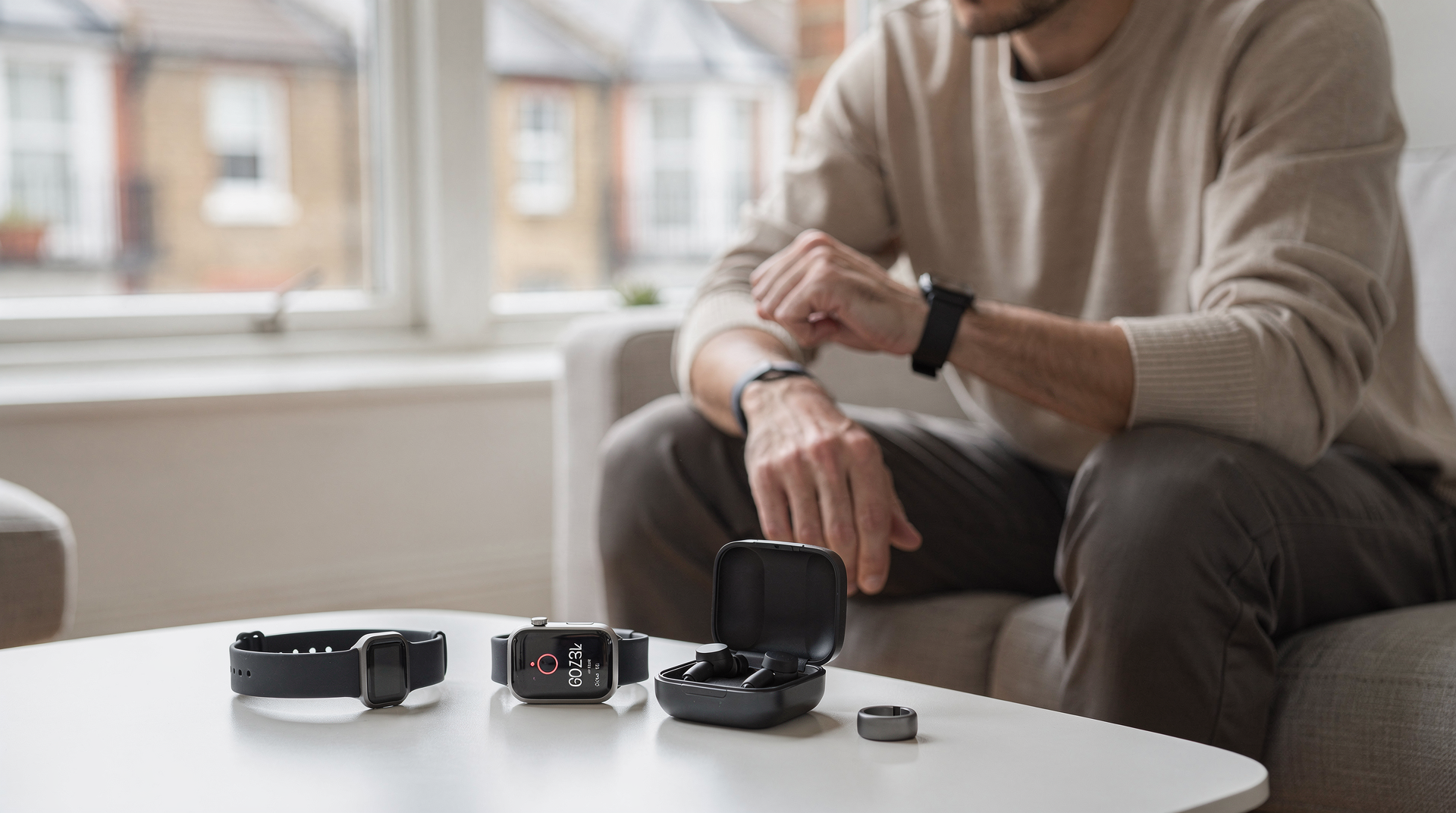
For consumers in the UK, that evolution is especially visible in the overlap between smartwatches, rings, and advanced fitness bands. Some remain lifestyle products. Others are edging closer to wellness tools and, in limited cases, medical-support functions. What’s fascinating is how the same sensor package—an optical heart rate monitor and accelerometer—can serve such different purposes depending entirely on the software interpreting the signals. A runner sees pace zones; someone managing stress sees heart rate variability trends. The hardware is converging while the user experience diverges.
The maturity ladder: how the category has changed
A useful way to understand wearables is to look at them in stages of maturity.
| Stage | Main purpose | Typical features | User value |
|---|---|---|---|
| Basic activity tracker | Motivation and habit building | Steps, calories, basic sleep, move reminders | Helps people become more active |
| Performance-focused wearable | Training and recovery | GPS, heart rate zones, workout load, VO2 max estimates | Useful for runners, cyclists, and gym users |
| Wellness wearable | Daily self-awareness | Stress metrics, sleep insights, temperature trends, breathing prompts | Helps users understand energy and recovery |
| Health-monitoring wearable | Ongoing signal tracking | Irregular rhythm notifications, AFib screening on approved features, pulse ox, temperature, ECG on some devices | Supports early detection and better conversations with clinicians |
The progression is not just about adding features. It changes the user question from How active was I today? to What is my body doing over time, and is something changing? That’s a profound shift in the relationship between person and device—from occasional check-ins to continuous background awareness.
Why the market is moving toward health monitoring
Three forces are driving the change.
- Sensors are better: Smaller chips and improved algorithms make it possible to read more signals continuously without killing battery life.
- Consumers expect more: People now want wearables to explain sleep, stress, recovery, and heart health—not just count movement.
- Health care is becoming more data-aware: Many users want devices that can help them notice patterns before a routine check-up or GP visit.
In practice, this means the value proposition has shifted from one-off measurements to trend analysis. A single high heart rate reading is rarely useful on its own. A 30-day pattern can be. I’ve spoken to users who brought six months of resting heart rate data to their GP after noticing a gradual climb—something no single measurement would have caught. That’s the real-world impact of this shift, and it’s what separates the new generation of devices from the pedometers of a decade ago.
What modern wearables can actually monitor
Not every feature is equal, and not every reading is medically meaningful. The most common categories are:
1. Activity and training data
These are still the foundation.
- Steps and distance
- Workouts and pace
- Heart rate during exercise
- Recovery estimates
- Training load and VO2 max approximations
This level is best for users who want to stay active or train for events. It is also the easiest to interpret.
2. Sleep and recovery signals
Sleep tracking has become one of the most important upgrade paths.
- Sleep duration
- Sleep timing consistency
- Restlessness and awakenings
- Sleep stage estimates
- Overnight heart rate and heart rate variability
The key word here is estimate. Wearables can identify trends and rough sleep architecture, but they are not a substitute for a sleep lab. What they do brilliantly, however, is reveal habits—like the three glasses of wine that consistently fragment deep sleep, or the late-night screen time that delays sleep onset by 40 minutes.
3. Wellness and stress indicators
These features are designed to show how the body responds through the day.
- Heart rate variability trends
- Stress scoring
- Breathing prompts
- Skin temperature variation
- SpO2 trends on some devices
These are most useful when read over time, not minute by minute.
4. Health-monitoring features
This is where the category becomes more sensitive.
- Irregular rhythm notifications
- ECG features on some devices
- High and low heart rate alerts
- Fall detection
- Menstrual and cycle tracking with temperature-based insights
- Blood oxygen measurements in supported models
These can be genuinely useful, but they also come with limits. Some features are regulated differently by market, and availability can vary by country, device generation, and app version. In the UK, for instance, the ECG app on certain devices has been cleared by regulators, but not all advertised features make it across the Atlantic or through MHRA approval. Always check what’s actually available rather than assuming global marketing applies locally.
What changed in the user journey
Early wearables were bought, worn, and forgotten after a few weeks. That still happens, but the better health-focused devices are built for longer-term use because their value improves with historical data.
This creates a new user journey:
- Start with motivation: step counts, streaks, workouts, and reminders.
- Notice patterns: poor sleep after late meals, elevated resting heart rate during illness, or low recovery after heavy training.
- Act on trends: adjust sleep, training, hydration, or stress management.
- Escalate when needed: use alerts or exported data to start a conversation with a GP or clinician.
That sequence is the real evolution. The device is no longer only telling you what happened today. It is helping you connect the dots. What’s striking is how this mirrors the way people actually think about their health—not as isolated daily snapshots but as a continuous narrative with patterns that only become visible at scale.
Where wearables are useful, and where they are not
The main value of wearables is awareness, not diagnosis.
They are strong at:
- spotting changes over time
- prompting healthier habits
- surfacing abnormal trends
- helping users understand recovery and strain
They are weaker at:
- giving a definitive medical answer
- replacing professional tests
- handling poor fit, bad skin contact, or inconsistent wear
- interpreting context such as illness, medication, alcohol, travel, or stress
A wearable can flag a pattern. It cannot tell you why it happened with certainty. This is a crucial boundary that both manufacturers and users need to respect—the difference between a helpful nudge and a false sense of diagnostic certainty.
How to judge quality as the category gets more advanced
As wearables become more health-oriented, the buying criteria change too.
For basic fitness use, prioritise:
- battery life
- comfort
- app clarity
- workout tracking
- sync reliability
For wellness and health monitoring, prioritise:
- sensor consistency
- alert quality
- data history and trends
- app explanations that are easy to understand
- compatibility with your phone and ecosystem
- privacy controls and data-sharing settings
A beautiful dashboard is not enough. If the readings are noisy, the notifications are vague, or the app makes every overnight blip look alarming, the device becomes harder to trust. I’ve tested devices where the stress score bounced around so dramatically that users started ignoring it entirely—exactly the opposite of what health monitoring should achieve.
A simple framework for choosing the right wearable
If you are deciding what to buy, start by asking where you are on the maturity ladder.
If you are a beginner
Choose a tracker that makes movement obvious and easy.
Good signs:
- simple goals
- clear step and sleep summaries
- low friction charging
- comfortable design
- affordable replacement if you stop using it
If you train regularly
Look for performance features.
Good signs:
- accurate heart rate during exercise
- GPS quality
- workout zones
- recovery insights
- strong battery during long sessions
If you care about health trends
Focus on monitoring, not just motivation.
Good signs:
- overnight data that is consistent
- useful alerts without too many false positives
- readable graphs over weeks and months
- clear explanations of what the device can and cannot infer
If you want a more medical-adjacent tool
Check the feature’s status carefully.
Questions to ask:
- Is the feature available in the UK?
- Is it approved or cleared for the intended use?
- Does the device say it is for wellness or medical support?
- Can you export data easily?
Common mistakes buyers make
Many people upgrade too quickly and pay for features they never use.
Typical mistakes include:
- choosing a device for a single headline feature
- treating every health metric as a diagnosis
- ignoring fit, which affects sensor accuracy
- assuming a higher price guarantees better medical insight
- buying without checking whether the feature works in the UK
- forgetting that battery life affects compliance; if you do not wear it, it cannot monitor anything
The last point deserves emphasis: I’ve seen people buy sophisticated health-monitoring smartwatches only to leave them on the charger half the time because the battery dies within a day. A device that’s not on your wrist generates no data. Sometimes a simpler tracker with a week-long battery tells you more about your health simply because you actually wear it.
What the next phase of wearables is likely to look like
The next stage is not just “more sensors.” It is better interpretation.
Expect wearables to move toward:
- more personalised baselines
- better detection of deviations from your normal pattern
- stronger integration with health apps and clinical workflows
- less emphasis on raw numbers, more on context and action
- form factors beyond watches, including rings and lighter always-on devices
The direction is clear: wearables are becoming less like gadgets and more like ambient health companions. The most interesting developments I’m tracking aren’t hardware breakthroughs—they’re in the software layer that learns what’s normal for you and surfaces only meaningful deviations. That’s when wearables stop shouting and start whispering useful things at the right moment.
Practical checklist before you buy
- Decide whether you want fitness, wellness, or health monitoring.
- Check whether the key features are supported in the UK.
- Read what the device measures continuously and what it only measures on demand.
- Compare battery life in real-world use, not just the spec sheet.
- Make sure the app presents trends clearly.
- Review privacy settings before you start syncing personal health data.
- Test comfort, because sensor quality depends on regular wear.
FAQ
Are wearables medical devices?
Some features on some devices may be regulated or clinically validated, but many wearables are still primarily consumer wellness products. You should check the device’s intended use and UK availability before relying on any specific health feature.
Can a wearable detect illness?
A wearable can sometimes show indirect signs such as elevated resting heart rate, disrupted sleep, or temperature changes. It cannot diagnose illness on its own.
Is a smartwatch better than a fitness tracker for health monitoring?
Not always. Smartwatches usually offer broader features, but some bands and rings are better for battery life, comfort, or overnight tracking. The best device depends on what you need most.
How accurate are wearable health metrics?
Accuracy varies by sensor type, fit, activity, and the specific metric being measured. Trend tracking is often more useful than treating any single reading as exact.
What matters most when using a wearable for health?
Consistency. Wearing the device regularly, keeping the fit correct, and reviewing trends over time matter more than chasing one-off readings.
Wearables are no longer just tools for counting steps. They are becoming everyday health monitors that help people notice patterns, manage routines, and recognise when something has changed enough to matter.