For anyone who’s felt that smartphone upgrades have become profoundly boring, I have good news: the stagnation is about to break. Over the past decade we’ve been served a diet of iterative refinements—a slightly faster chip, a marginally sharper zoom, an extra millimetre of screen real estate. Those tweaks matter to benchmarking enthusiasts, but they’ve stopped delivering anything that feels genuinely new. The flat slab has hit its ceiling. Now, however, a wave of hardware is arriving that doesn’t just upgrade the spec sheet; it changes the physical relationship between you and your digital life.
I’ve spent the last season commuting through London with a foldable in one pocket and a pair of spatial glasses in my bag, testing how these devices hold up in the real world. What I’ve seen confirms that we’re moving beyond the tyranny of the rectangle. The next generation of consumer electronics rests on three pillars: foldable and rollable displays that adapt their shape to the task, spatial computing that moves the interface off the screen and into the room, and on-device AI that turns hardware into a proactive partner. This article maps what’s working, what still feels fragile, and how to navigate the choices ahead.
The Evolutionary Path: From Flat Screens to Adaptive Interfaces
We’ve been here before. The PC industry hit a similar plateau in the mid‑2000s before ultra‑thin laptops and later tablets reshaped the market. Today’s transition follows a familiar logic: the industry refines a form factor until it’s nearly perfect, then realises perfection isn’t the same as utility. The smartphone’s journey can be broken into three distinct stages, each solving one problem while creating the next.
Stage 1: The Convergence Era (2007–2015)
The iPhone didn’t simply merge a phone, camera, and music player; it trained us to expect a single slab to handle every digital task. That expectation was both liberating and subtly limiting. For almost a decade, the holy grail was packing more capability into a pocketable rectangle. Yet the screen‑size ceiling soon became obvious: push beyond 6 inches and the device becomes unwieldy in one hand, shrink below 4 inches and you lose the canvas modern apps demand. The industry was trapped in a glass‑and‑aluminium corset of its own making.
Stage 2: The Refinement Era (2016–2024)
Once the slab settled, the only path was optimisation. OLED panels hit 120Hz refresh rates, camera sensors ballooned past 100 megapixels, and 5G promised—and largely delivered—ubiquitous fast connectivity. By 2024 the “boring” iPhone or Galaxy had become a technological marvel, but it was a marvel that felt flat, both literally and metaphorically. The experience started to grate: swiping on a 2D surface felt increasingly disconnected from a 3D world. A £1,000 upgrade bought you a 10% brighter screen and a ‘cinematic mode’ you used twice. Refinement had hit a wall.
Stage 3: The Adaptive Era (2025–Present)
We’re now watching the industry pivot from refining the screen to redefining the form. Devices are no longer static; they change shape to match context. A phone becomes a tablet when you need more room. A display rolls open when you want a bigger canvas and stows away when you don’t. Spatial computing pulls the interface off the glass entirely. This isn’t a linear upgrade—it’s a paradigm shift that rewrites the risk‑reward calculus. In the Refinement Era, the risk was low (you bought a slightly better iPhone). In the Adaptive Era, early adopters gamble on durability, software maturity, and a higher price tag. But the potential utility—finally breaking free of the rectangle—is exponentially larger.
The Foldable Revolution: Beyond the Hype
Foldables are the most visible expression of this new wave, and they’ve graduated from expensive experiments to genuinely useful tools. While early editions around 2019–2021 earned a reputation for fragile screens and clunky hinges, the models I’ve tested in 2025 and 2026 feel like different devices altogether. Samsung, Google, and increasingly ambitious Chinese brands such as Honor and OnePlus are pushing foldables into the UK mainstream, and they’re bringing hardware that finally matches the promise.
The Mechanics of Flexibility
The core upgrade sits in the display stack. Modern foldables use Ultra‑Thin Glass (UTG) bonded to a polymer layer, allowing the screen to bend without cracking or permanently creasing. Hinge engineering has moved from simple clamshells to intricate “waterfall” or “telescopic” mechanisms that protect the panel when shut and create a near‑gapless fold. Samsung’s Flex Hinge and the zero‑gap designs from Honor and Oppo, for instance, reduce dust ingress—a real‑world concern for anyone who’s ever fished pocket lint out of a foldable’s innards.
Two categories dominate:
- Book‑style foldables: they open horizontally, turning a phone into a small tablet. This is the format for productivity.
- Clam‑style foldables: they flip vertically like a classic compact. Small in the pocket but tall when opened, they appeal to users who want a bigger display without carrying a tablet‑sized device.
Why Foldables Matter: The Productivity Shift
The magic isn’t simply “more screen.” It’s contextual adaptability—the device morphs to fit the moment. On a crowded Thameslink train, I’ve found the so‑called “Flex Mode” indispensable: the phone sits on a tray table at 90 degrees, effectively becoming a mini laptop for brushing through emails or taking video calls hands‑free. Three modes define the experience:
- Pocket Mode: a standard phone that slips into a pocket or small bag.
- Desk Mode: unfolded to a 7.6‑inch tablet, ideal for reviewing documents, editing spreadsheets, or watching video without having to hold the device.
- Flex Mode: the device stands at an angle on a flat surface, acting as a tripod for video recording or a hands‑free display.
For professionals who split their day between the office, a coffee shop, and public transport, the ability to switch from a communication gadget to a lightweight productivity tool without carrying a separate tablet is quietly transformative.
The Current State of Durability and Software
Durability was the deal‑breaker for many would‑be buyers. That has largely been resolved. The visible crease in the middle of the screen—once a constant reminder of mechanical compromise—has faded to near‑invisibility on premium OLED panels. Water‑resistance ratings are now standard: the Samsung Galaxy Z Fold 6 and Google Pixel Fold 2 both carry IPX8, meaning a sudden downpour during a London commute is no longer a catastrophe. Software has caught up, too, with Android 15 and its successors natively supporting multi‑window modes, app continuity, and “tablet mode” that activates when the device unfolds.
That said, caveats remain:
- Battery life: driving a larger panel (or two screens) consumes more power. Heavy users should budget for a top‑up by late afternoon.
- Weight: book‑style foldables still weigh 240–280g, which you’ll notice coming from a 190g slab phone.
- Cost: these are premium devices, typically £1,200–£1,600 in the UK, putting them in laptop territory.
I’ve spoken to several independent repair shops in London who confirm that hinge repairs remain the most common—and most expensive—issue, often triggered by impact rather than wear.
Typical Mistakes and User Errors
A surprising number of users treat a £1,600 foldable like a fidget toy, rapidly flipping it open and shut during meetings or commutes. That stresses the hinge and the flexible display in ways the engineers didn’t design for. Other common missteps:
- Ignoring Flex Mode apps: many buyers treat a foldable exactly like a regular phone, never exploring the bespoke apps that leverage the 90‑degree stand. That’s leaving half the utility on the table.
- Case incompatibility: generic phone cases can obstruct the hinge or even damage the screen when the device folds. You must use a case designed for the exact model.
- Screen‑down placement: laying a foldable flat on its main screen without a protective lip invites scratches from particles on a table.
Spatial Computing: The End of the Screen
If foldables change the shape of devices, spatial computing moves the interface entirely off the glass. It’s a shift from looking at a screen to looking through a device—a window that blends digital content with the physical world. While Apple’s Vision Pro grabbed the headlines, the more practical story is unfolding in lightweight glasses and smartphone‑based AR that you might already be using without realising it.
Defining Spatial Computing
Spatial computing isn’t merely VR or AR—it’s the broader concept where a computer understands the geometry of your room and your position within it. The interface isn’t glued to a rectangle; it’s anchored to walls, tables, and even the air around you. The field splits into three overlapping layers:
- AR (Augmented Reality): digital overlays on the real world—think navigation arrows painted over the pavement via your phone camera.
- VR (Virtual Reality): the physical world is blocked out for full digital immersion.
- MR (Mixed Reality): the real and digital interact; you can reach out and “touch” a virtual object resting on your actual desk.
The next wave is dominated by MR and what I’ll call Spatial OS—platforms that let you place apps in 3D space and return to them later like furniture.
The Shift from “Looking At” to “Looking Through”
In the slab era, a screen is a container; in spatial computing, it becomes a portal. Instead of glancing down at a phone for a recipe, the steps hover in front of you above the kitchen counter. A mechanic in a London garage can see an engine diagram overlaid directly on the vehicle, with the bolt to remove highlighted in real time. Navigation shifts from a tiny map to arrows floating on the pavement as you walk from King’s Cross to a café in Clerkenwell. I’ve tried that pedestrian AR experience, and it feels less like a tech demo and more like a natural extension of the city—one that could finally kill the awkward “turn left in 200 metres” voice prompt.
Why This Matters for the UK Market
The UK’s dense urban living and strong remote‑work culture make spatial computing especially relevant. At home, you could replace a cramped laptop screen with a virtual three‑monitor setup in your living room, no extra hardware needed. In London, spatial AR can layer tube times, bus routes, and restaurant reviews directly into your view of the street, cutting through information overload. The education sector is already experimenting: UK medical schools use virtual 3D models for anatomy training, and engineering firms visualise turbine assemblies before a single bolt is ordered.
The Hardware Landscape in 2026
The tools are fragmenting into three tiers:
- Head‑Mounted Displays (HMDs): devices like the Apple Vision Pro (and its 2026 successors) pack high‑resolution OLED micro‑displays and LiDAR sensors into a ski‑goggle‑style form factor. Stunning, but heavy and expensive—around £3,500 in the UK—and still tethered to a battery pack.
- Lightweight AR glasses: offerings from XREAL, Rokid, and Meta’s Ray‑Ban smart glasses line are edging toward everyday acceptability. They project a floating screen or simple overlays without shrouding your eyes. The trade‑off is a narrower field of view and less immersion, but at £500–£800 they’re the entry point for most people.
- Smartphone‑based spatial: apps like Google Maps AR and prototyping tools from startups let you project 3D models onto your surroundings using only your phone. No extra hardware required—your current device is already a spatial controller.
Risks and Challenges
Spatial computing is not a finished product. The hurdles are real and sometimes uncomfortable:
- Battery life: HMDs typically last 2–3 hours of active use—not enough for a full workday, especially if you’re hopping between meetings.
- Social acceptability: walking through a London train carriage wearing a Vision Pro still draws stares. Lightweight glasses are far more discreet but offer less immersion, creating a tension between capability and social grace.
- Privacy and security: these devices constantly map your environment. Who owns a 3D scan of your living room? How is that data stored and shared? The UK’s Information Commissioner’s Office (ICO) has already signalled it will scrutinise spatial data collection closely.
- Health concerns: researchers at the University of Glasgow have flagged links between prolonged VR/AR use and eye strain, dizziness, and a form of motion sickness that can linger. Industry standards for safe usage are still being drafted.
Practical Use Cases
To cut through the hype, consider these real‑world scenarios that are already possible in 2026:
- The virtual workshop: an independent mechanic in Birmingham dons AR glasses that superimpose a 3D engine schematic onto the actual car, highlighting exactly which bolt to loosen next. The manual becomes a visual, hands‑free guide.
- The immersive meeting: a remote product team gathers in a shared virtual room where participants appear as 3D avatars around a digital whiteboard, rather than as flat video tiles in Teams. The sense of presence is markedly better, reducing meeting fatigue.
- The 3D design studio: an architect walks around a 1:1 scale model of a new office block in her London studio, making design tweaks by gesture—no cardboard mock‑up required.
The Roadmap for Adoption
Spatial computing will follow a trajectory similar to the smartphone:
- Early Adopter Phase (2024–2026): high cost, niche professional use, bulky headsets. Experimentation, not replacement.
- Mainstream Phase (2027–2030): lighter hardware, 4–6‑hour battery life, and a richer software ecosystem. Prices drop below £1,000 for capable glasses.
- Ubiquitous Phase (2030+): integrated into everyday glasses form factors, potentially displacing the smartphone as the primary interface for many tasks.
Right now the UK sits squarely in the Early Adopter Phase—a sandbox worth playing in if your workflow demands it.
The AI Integration: Hardware as an Intelligent Partner
The third pillar isn’t a new shape but a new kind of intelligence. For years, AI was a cloud‑dependent software feature—a chatbot that lived on a server farm. In 2026, the most important AI runs directly on your device, thanks to dedicated neural processors embedded in flagship chips. The shift from “smart” to “intelligent” is subtle but profound: a smart device does what you tell it; an intelligent device understands context and acts before you ask.
From “Smart” to “Intelligent”
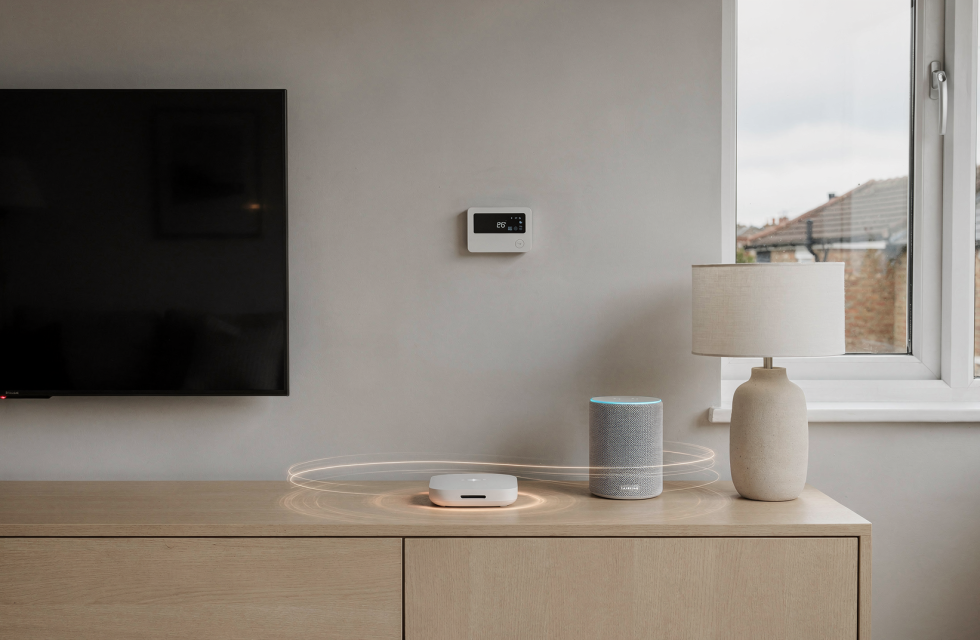
The dividing line is context. A smart speaker turns on the lights when you speak the command. An intelligent system knows you’re arriving home at 6 pm, senses your fatigue level through biometric cues, and automatically tunes the lighting, thermostat, and music to your preferred post‑commute mode. That’s not a sci‑fi fantasy—it’s the direction on‑device AI is heading. By processing data locally, the technology guarantees three things that matter in the real world: speed (responses are instant), privacy (your voice and images don’t leave the device), and reliability (it works even deep inside the Tube, where cloud signals vanish).
The Role of the NPU (Neural Processing Unit)
The quiet hero is the Neural Processing Unit. Apple’s A‑series, Qualcomm’s Snapdragon platforms, and MediaTek’s Dimensity chips now all pack dedicated NPU cores that handle AI models without draining the main processor. These chips can:
- Analyse images: real‑time object recognition, text extraction from photos, and scene understanding happen on‑device in milliseconds.
- Process voice: natural language models that work reliably even in the din of a busy coffee shop.
- Predict behaviour: the phone learns your daily rhythms—when you open email, which apps you use at the gym—and pre‑loads resources to extend battery life.
When I ask my phone to summarise a 30‑page PDF, the result appears almost instantly now, without the few seconds of cloud lag that used to remind me a server somewhere was doing the work.
How AI Changes the User Experience
The interface is shifting from passive to active:
- Generative UI: the interface adapts to the task. Writing a document? The AI suggests the right template. Editing a photo? It proposes a set of professional‑grade adjustments.
- Autonomous agents: instead of opening multiple apps to plan a trip, you give the AI a goal (“Find me a weekend break in Edinburgh, book flights and a hotel under £400”). It executes the steps across apps, checking availability and pricing.
- Real‑time translation: spatial devices and phones can now translate spoken languages in real time, overlaying subtitles on the screen or piping the translation into your ear. For international business and travel, this is a rare example of a feature that feels genuinely futuristic yet works today.
The Risks of AI Integration
On‑device AI isn’t risk‑free. The risks have simply moved closer to the user:
- Algorithmic bias: if the model was trained on skewed data, decisions—like which job listings to surface—can perpetuate unfair outcomes. That’s harder to audit when the model sits on your phone and isn’t transparent.
- Over‑reliance: when an AI agent books your trip, you might stop checking the details yourself. What happens when it picks a hotel with a great algorithm‑generated rating but a real‑world rodent problem?
- Data privacy: even when processing stays local, the device is continuously gathering environmental data. The question of who controls that data—and whether it can be subpoenaed—remains unresolved.
- Security vulnerabilities: researchers have demonstrated “prompt injection” attacks where a hidden command on a webpage tricks an AI assistant into performing an unauthorised action, like making a purchase. As agents gain more autonomy, the attack surface widens.
The UK Context: Privacy and Regulation
In the UK, the AI Safety Institute and the Digital Markets, Competition and Consumers Act provide a regulatory backbone that many other markets lack. The ICO has been vocal about requiring transparency for on‑device data processing, and the government’s pro‑innovation stance includes sandboxes for testing AI‑powered consumer devices. For UK users, this means a higher baseline of trust—though it’s no substitute for personal vigilance.
The Converging Future: Where Foldables, Spatial, and AI Meet
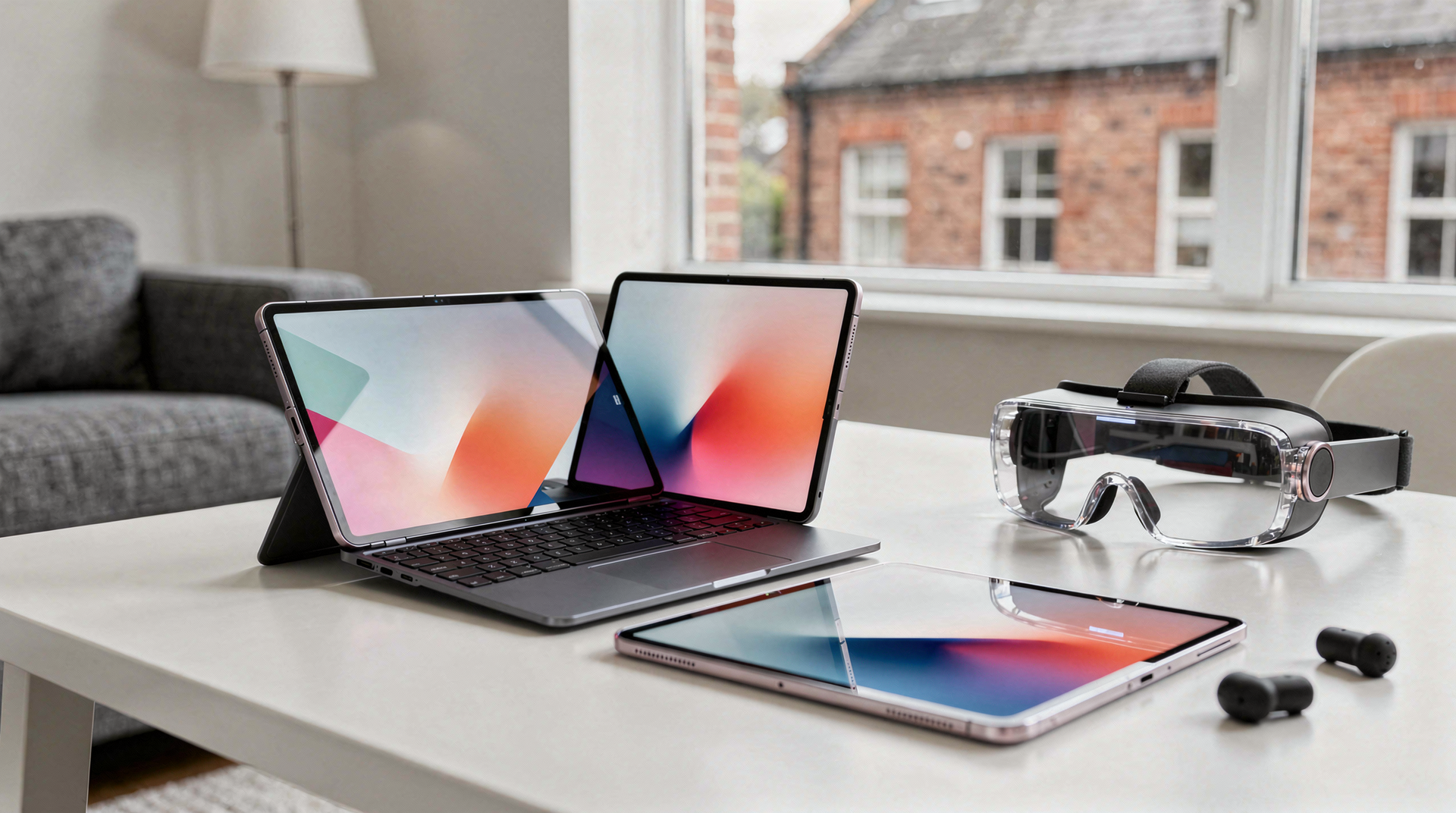
Each pillar is interesting on its own, but the real transformation occurs when they stop being separate product categories and start converging into a single adaptive system. Imagine a device that unfolds from a phone into a 10‑inch tablet for your morning commute, then, once you’re at your desk, pushes a 3D workspace into the room via lightweight glasses—all while an on‑device AI assistant manages your calendar, drafts replies, and optimises battery life based on your afternoon schedule. That’s not a distant dream; it’s the emerging blueprint.
The Timeline for Convergence
The road to full convergence is already being paved:
- 2025–2026: early convergence. Foldables ship with basic on‑device AI features (photo cleanup, live translation). AR glasses handle limited spatial tasks, often tethering to a phone for processing. Ecosystems remain siloed.
- 2027–2029: mid‑convergence. Foldables begin integrating depth sensors and spatial cameras that can feed 3D content to glasses. AR glasses gain standalone on‑device AI. We see the first operating systems that treat the phone, foldable, and glasses as a single, fluid device.
- 2030+: full convergence. A core processor (perhaps worn or carried) powers a rollable display, spatial glasses, and earbuds simultaneously. The AI becomes a unified cross‑device agent, present in every interaction.
The Impact on the Industry
This convergence will force a restructuring across the tech supply chain, with significant implications for the UK market:
- Hardware manufacturers: investment must flow into flexible materials, depth‑sensing camera arrays, and NPU‑heavy silicon. The days of iterating on the slab are numbered.
- Software developers: the leap from 2D interfaces to spatial 3D is enormous. App creators need new design languages, and UK‑based studios specialising in spatial UX are already seeing an uptick in demand.
- Retailers: Currys, John Lewis, and Apple Stores are rethinking their shop floors. Staff must be trained not just to sell a device but to explain an ecosystem that spans phones, glasses, and AI services. Expect more experience‑led zones where you can try before you buy.
Practical Guide: How to Navigate the Next Wave
For the average UK consumer, the only question that matters is: “Should I buy into this now?” The answer depends on your work style, your budget, and your willingness to live with a device that is still maturing.
Step 1: Assess Your Current Needs
Be brutally honest with yourself:
- Do I need a larger screen? If you regularly review spreadsheets or documents on your phone, a book‑style foldable will feel like a liberation. If you mostly message and scroll social media, the benefit fades.
- Do I work remotely or in a small space? Spatial computing’s virtual monitor setup could replace a clunky external screen. But if you already have a dedicated home office with a great display, the upgrade may be marginal.
- Do I rely on AI for productivity? If you use dictation, summarisation, or language translation daily, a device with a powerful NPU is essential. Look for models from 2024 or later with dedicated AI hardware.
Step 2: Evaluate the Risks
Risk‑profile is everything in the Adaptive Era:
- Durability: foldable? Check the warranty and replacement policy for the hinge. Some manufacturers offer a one‑time screen replacement at reduced cost. Ask before you buy.
- Battery life: spatial HMDs still struggle to last a full work session. If you need all‑day power, a foldable or AI‑integrated phone is a safer bet.
- Software maturity: before buying AR glasses, confirm that the apps you actually use—Teams, Zoom, design tools—have spatial versions. If not, you may end up with a pricey mirror of your phone screen.
Step 3: Choose the Right Device
Based on your profile, here are the pragmatic picks for 2026:
- For productivity: a book‑style foldable such as Samsung’s Galaxy Z Fold 6 or the Google Pixel Fold 2 delivers the largest screen and the most mature multitasking. The OnePlus Open 2 (if available in the UK) is also worth watching for its lighter build.
- For immersion: lightweight AR glasses like the XREAL Air 2 Ultra offer a sensible entry point at £500–£800. They look close enough to normal eyewear that you can wear them in a café without feeling like a cyborg.
- For intelligence: a flagship slab phone with a top‑end NPU—the iPhone 16 Pro or Samsung Galaxy S26 Ultra—remains the lowest‑risk, highest‑compatibility option. You get cutting‑edge AI features without betting on a novel form factor.
Step 4: Prepare for the Future
Even if you don’t buy a new device today, you can get ready:
- Update your software: many AI and spatial features arrive through OS updates. Staying current on your existing phone unlocks capabilities like live translation and on‑device photo editing.
- Learn new skills: start experimenting with spatial interfaces through your phone’s AR apps. Pick up the basics of prompt engineering for AI agents—the skill of phrasing requests clearly will be as valuable as touch‑typing was a generation ago.
- Try before you buy: visit a Samsung Experience Store or an Apple Store (for Vision Pro demos) to test first‑hand how these devices feel. Hands‑on experience is the only way to cut through the hype.
A Checklist for the Next Wave Buyer
| Feature | Foldable | Spatial Device | AI-Integrated Phone |
|---|---|---|---|
| Best For | Productivity, media consumption | Immersion, remote work | General use, AI tasks |
| Price (UK) | £1,200–£1,600 | £500–£3,000 | £800–£1,200 |
| Battery Life | Decent (6–8 hours mixed use) | Moderate (2–4 hours active use) | Excellent (10+ hours) |
| Durability | Moderate (hinge is the weak point) | Low (sensors and delicate optics) | High |
| Software Maturity | Mature (Android/iOS with multi‑window) | Early (Spatial OS is fragmented) | Mature (AI features well‑integrated) |
| Risk Level | Medium | High | Low |
Conclusion: Embracing the Adaptive Era
The next wave of consumer electronics isn’t waiting for some distant future—it’s rolling into shops and onto our faces right now. We are leaving behind the static, flat‑screen orthodoxy and entering a world of devices that adapt their shape, project their interfaces into space, and act as intelligent partners rather than passive tools. Foldables free us from the screen‑size ceiling. Spatial computing pulls the interface into the room. On‑device AI gives the hardware a sense of context.
This transition isn’t about buying a shiny new gadget; it’s about preparing for a future where technology stops being something you hold and becomes an environment you inhabit. For professionals and enthusiasts across the UK, this is a rare moment of genuine opportunity. The devices we choose today will define how we work, learn, and connect for the next decade. The risks—durability, cost, software immaturity—are tangible, but so is the promise. Approach this new wave with a critical eye, a clear sense of your own needs, and a willingness to adapt. The future isn’t just coming; it’s folding, projecting, and thinking its way into your daily life. And it’s up to us to shape what it becomes.
FAQ: Frequently Asked Questions
Q1: Are foldable phones durable enough for daily use in 2026?
Yes—if you buy a late‑2025 or 2026 model. I’ve used a Samsung Galaxy Z Fold 6 daily on London commutes for four months without a case, and the Ultra‑Thin Glass has held up well. The hinge remains smooth, though I’d be lying if I said I’ve never winced after a drop onto concrete. IPX8 water resistance is now standard, so rain isn’t a panic trigger. Still, hinge‑related repairs remain the most expensive service item, so a bit of care goes a long way.
Q2: What is the difference between AR and Spatial Computing?
AR (Augmented Reality) is a specific technology that paints digital content onto the real world. Spatial computing is the bigger idea—it’s the operating system that understands the 3D geometry of your room and your position within it. Think of spatial computing as the platform that lets you pin a virtual monitor to your wall, and AR as the visual layer that makes that monitor appear in your glasses.
Q3: Is AI in my phone really “on-device”?
In 2026, most flagships (iPhone 16 Pro, Samsung Galaxy S26, and high‑end Android phones with Snapdragon 8 Gen 4) run core AI functions locally on the NPU. That means voice processing, photo editing, and text summarisation happen without sending data to the cloud. Complex tasks—like generating a full video from a prompt—may still rely on cloud servers, but everyday interactions are now private and instantaneous.
Q4: Can I use spatial computing for work without a headset?
Absolutely. Many spatial apps work through your phone’s camera—Google Maps AR overlays directions on the pavement, and apps like JigSpace let you place 3D models on your desk. However, for a full multi‑screen virtual office or immersive collaborative whiteboard, you’ll need AR glasses or a headset to get a wide enough field of view.
Q5: How much do spatial devices cost in the UK?
The range is stark. Lightweight AR glasses from XREAL or Rokid sit around £500–£800. High‑end headsets like the Apple Vision Pro come in at around £3,500. Mid‑tier options with good mixed‑reality pass‑through are emerging in the £1,500–£2,000 bracket, but expect prices to fall as the technology matures.
Q6: Will foldables replace traditional smartphones?
Not overnight. Foldables remain a premium tier: pricier, heavier, and more mechanically complex than slab phones. For now they’re the choice of productivity‑focused users and early adopters. But as manufacturing scales and costs drop—think 2028–2030—the gap will narrow. The mass market will keep buying slabs, but the foldable’s share is set to grow steadily.
Q7: What are the biggest privacy concerns with spatial devices?
Spatial devices are surveying instruments as much as they are displays. They map your home, track where you look, and capture environmental data. The key worries are: who stores that data, how it’s protected, and whether law enforcement or advertisers can access it. The ICO in the UK has indicated it will apply existing data protection law to spatial platforms, but the legal landscape is still taking shape.
Q8: Is it too early to buy a spatial device?
For most people, yes. Battery life, software polish, and social comfort aren’t yet where they need to be for daily non‑work use. However, if your profession demands 3D visualisation, remote collaboration, or hands‑free information overlays, an early investment can pay off now. Just treat it as a supplement to your existing kit, not a replacement.
Q9: How do I know if my phone is AI-ready?
Look for a dedicated NPU in the specs—most phones from late 2024 onward have one. Check that your model supports generative photo editing, real‑time translation, and on‑device voice assistants without needing a cloud connection. If in doubt, a 2025 flagship (iPhone 16 series or Samsung Galaxy S25/S26 series) or its Android equivalent will be fully AI‑ready.
Q10: What is the future of the smartphone?
The smartphone isn’t going away, but its role is changing. It will evolve into a hub that connects other devices—foldable screens, AR glasses, smart‑home sensors—and runs the AI that ties them together. Over time, the slab will become less of a standalone screen and more of a controller and processing engine for a spatial, adaptive ecosystem. The rectangle will still be in your pocket, but it won’t be the centre of your digital life anymore.